
A manifesto on the metamorphosis of human habitat—from Dinocrates’ grid and the medieval university to the commercial cloning of Europe—and the formulation of the Loberithm matrix against the empty metrics of modern proptech.
I. The Living Organism and the Psychohistorical Cycle
Cities are not static assemblages of concrete, mortar, and steel; they are giant, living organisms—stony personifications of the political power, cultural memory, and human matter that animate them. They possess an immunological memory forged through plagues, scars carved by cataclysms, and distinct evolutionary trajectories. Like all complex systems, urban aggregations do not decay by accident. They obey a psychohistorical equation: a mathematical, predictable cycle of scale, density, entropy, and cultural retention.
History demonstrates that the trajectory of a metropolis follows a defined lifecycle:
- Extinction and Submersion: Metropolises that reached the zenith of ancient power only to be swallowed by environmental shift or historical oblivion (Alexandria, Atlantis, Babylon).
- Demotion from Empire to Ruin: Former capitals of global hegemony that collapsed into provincial shadows of their past, surviving merely on the memory of their former mass (Ancient Rome, Classical Athens).
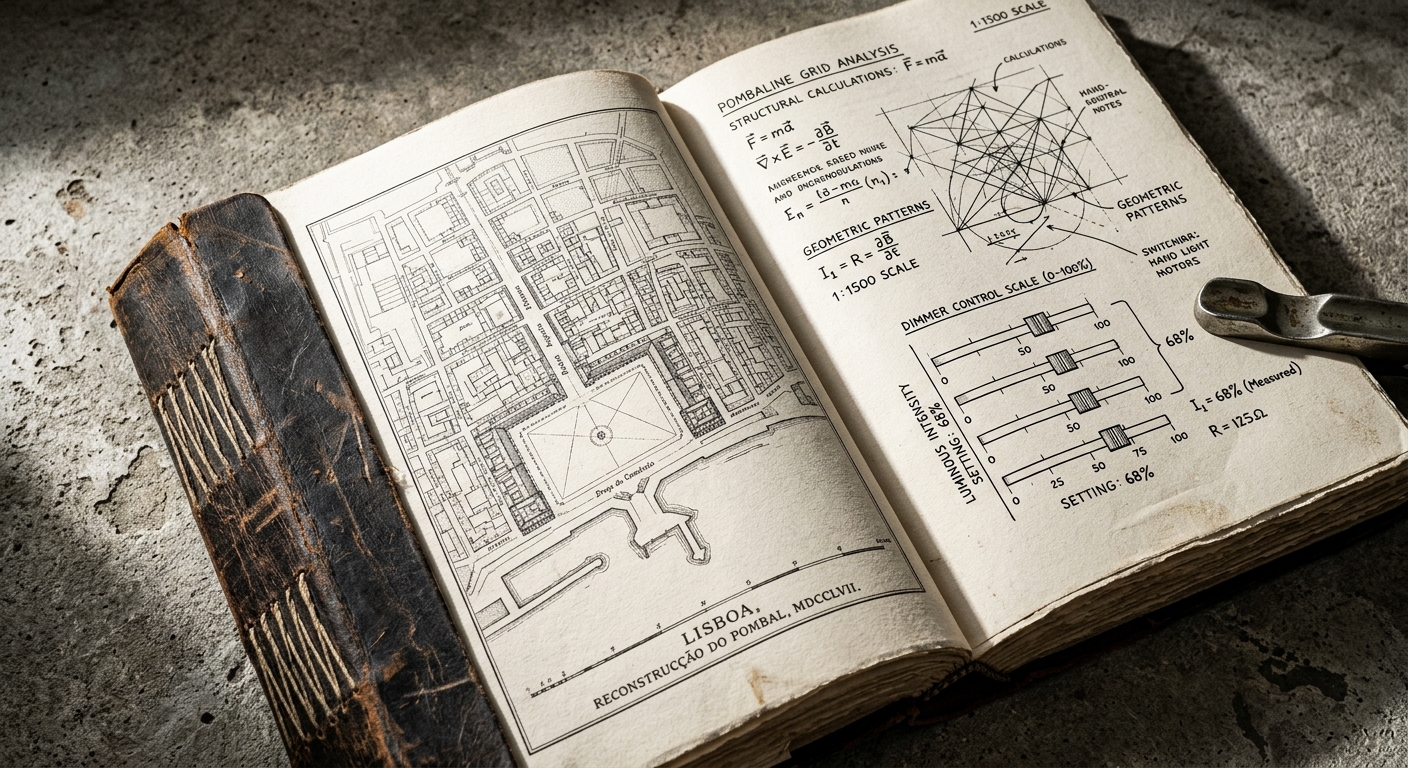
- Transmutation through Cataclysm: Urban centers forcibly reformatted by tectonic fire, war, or disaster, rising from their own ashes through structural breakthroughs—such as the post-1755 Pombaline reconstruction of Lisbon’s Baixa, engineered through the anti-seismic timber gaiola framework.
- The Zombie Metamorphosis: The contemporary condition wherein a city remains physically standing and financially lucrative, yet suffers brain death—its organs replaced by synthetic commercial clones and volatile human flows.
┌─────────────────────────────────────────────────────────────────────────┐
│                    THE PSYCHOHISTORICAL URBAN CYCLE                     │
├───────────────┬─────────────────┬───────────────────┬───────────────────┤
│    GENESIS    │    FLOURISH     │    SATURATION     │     NECROSIS      │
│  (The Grid)   │  (The Memory)   │  (The Extraction) │ (The Zombie City) │
└───────────────┴─────────────────┴───────────────────┴───────────────────┘
When an urban ecosystem ceases to function as a vessel for human continuity and becomes an unmediated financial asset, it undergoes necrosis. To evaluate space within this cycle requires abandoning the superficial e-commerce metrics of modern proptech. It demands a return to deep spatial archaeology.
II. The Four Epochs of Urban Architecture and Human Density
1. Antiquity: The Orthogonal Grid and the Entropy of the Insulae
The genesis of urban planning was an explicit declaration of philosophical order. When Dinocrates of Rhodes laid out the master plan for Alexandria under Alexander the Great, the grid was not conceived for real estate speculation; it was designed around the Library and the Mouseion—placing intellectual density at the geometric heart of the city.
However, the ancient world also revealed the primary failure of unmanaged density. In Imperial Rome, the monumental core of aqueducts and marble was surrounded by miles of precarious, multi-story timber-and-brick tenement blocks—the insulae. Overcrowded, perpetually vulnerable to fires, and lacking basic sanitation, the insulae represented the first structural crisis of human compression. When the central administration collapsed and trade routes severed, Imperial Rome plummeted from a metropolis of over a million inhabitants to a depopulated landscape of ruins grazing livestock.
       [ ALEXANDRIA ]                            [ IMPERIAL ROME ]
   Monumental Grid & Knowledge               The Entropy of the Insulae
 ┌─────────────────────────────┐           ┌─────────────────────────────┐
 │ Dinocrates' Orthogonal Plan │           │ High Density / Multi-story  │
 │ Center: Library & Mouseion  │    vs.    │ Fire Hazards / Sanitation   │
 │ Geometry as Philosophy      │           │ Collapse of Infrastructure  │
 └─────────────────────────────┘           └─────────────────────────────┘
2. The Middle Ages: The Fortress City and the University Anchor
The medieval era responded to instability by turning inward. The city became a fortress—a dense, organic network of narrow alleyways compressed within defensive stone walls. Space was scarce, hygienic conditions were precarious, and cities were repeatedly decimated by black plagues and epidemics.
Yet, within these stone containers, a vital transformation occurred: the birth of the European University.
                                [ THE MEDIEVAL CITY ]
                                          │
                   ┌──────────────────────┴──────────────────────┐
                   ▼                                             ▼
        [ PHYSICAL CONTAINMENT ]                      [ INTELLECTUAL ANCHOR ]
  • Compressed Defensive Walls                 • Birth of Universities (Bologna, Coimbra)
  • Organic, Narrow Mesh                       • Student Guilds & Scholars
  • High Plague Vulnerability                  • Regeneration of European Mind
In Bologna, Paris, Oxford, and Coimbra, the university emerged as a permanent anchor of human matter and intellectual generation. The student guilds and academic faculties provided an influx of thought that outlasted military sieges and epidemiological collapse. The medieval city survived its physical containment because its core retained a self-regenerating intellectual engine.
3. The Interwar Period: Machine Aesthetics, the Bauhaus, and Functionalist Zoning
The industrial explosion of the 19th and early 20th centuries overwhelmed historical urban boundaries, creating vast, polluted worker slums. In the wake of World War I, architects and theorists sought to solve the housing crisis through industrialization and raw material engineering.
This era produced two distinct paradigms:
- The Bauhaus (Walter Gropius): An attempt to unite art, craft, and industrial production, conceiving housing as a dignified, functional, and democratic environment for the human being.
- Functionalist Modernism (Le Corbusier & CIAM): The radical imposition of strict functional zoning—dividing the city into isolated sectors for living, working, leisure, and circulation, exemplified by the Ville Radieuse.
                          [ INTERWAR URBAN REVOLUTION ]
                                        │
           ┌────────────────────────────┴────────────────────────────┐
           ▼                                                         ▼
  [ THE BAUHAUS PARADIGM ]                                 [ LE CORBUSIER / CIAM ]
• Synthesis of Art & Industry                            • Rigid Functional Zoning
• Dignified Worker Housing                               • Destruction of Historic Fabric
• Human-Centric Craftsmanship                            • The Machine for Living
While concrete, steel, and glass allowed for unprecedented structural speed, the rigid execution of functionalist zoning stripped cities of their mixed-use organic texture. The machine-age ideals, when stripped of social responsibility, laid the groundwork for the sterile, car-centric suburban housing blocks of the late 20th century.
4. The Contemporary Era: Commercial Cloning, the “Non-Place,” and the Zombie City
Today, the European city faces its most dangerous existential crisis: not physical destruction by war or earthquake, but cultural erasure through commercial cloning and financial extraction.
Across Lisbon, Madrid, Barcelona, Bordeaux, and Rome, a devastating homogenization has occurred. The sensory landscape of the traditional city—the distinct aroma of roasted coffee and dried fruits from century-old neighborhood grocers, artisan workshops, and independent taverns—has been systematically eradicated. In their place stands a sterile, uniform storefront aesthetic:
  HISTORICAL METROPOLIS                          CLONED ZOMBIE CITY
┌─────────────────────────┐                    ┌─────────────────────────┐
│ Unique Olfactory Memory │                    │ 10 Global Corporate     │
│ Local Artisan Trade     │  ────────────────► │   Franchise Chains      │
│ Organic Neighborhood    │  [Financialization]│ Generic E-Commerce      │
│   Solidarity            │                    │   Storefronts           │
└─────────────────────────┘                    └─────────────────────────┘
The street-level experience of European capitals is now virtually identical. If one obscures the surrounding geography and landmark monuments, the pedestrian walks through an anonymous, algorithmically generated “non-place.”
This physical cloning is accompanied by a severe social fracture:
- The Disconnection from Local GDP: Property values and rental prices no longer reflect the wages or economic productivity of the local population. They are indexed to global mobile capital, short-term tourist platforms, and tax-exempt investment vehicles.
- The Precarious Fleets: The streets are populated by an anonymous workforce of gig-economy delivery riders—workers navigating the urban mesh with uniform backpacks and hollow expressions, supplying convenience to an increasingly isolated population.
- The Extraction of the Resident: Short-term rentals (Airbnb) and unregulated speculation turn residential neighborhoods into hotel districts. The local resident is expelled to distant, unserviced peripheries, destroying the intergenerational social fabric.
What remains of the city when its trade is cloned, its inhabitants displaced, and its social memory erased? A hollowed-out tourist set—a zombie city.
III. The Sovereign Exception: The Regulatory Shield
The decay of the city into a zombie state is not an inevitable law of nature; it is a choice of political permission. Where sovereign regulation intervenes, the cycle of financial cannibalization can be halted.
A primary example exists in Denmark:
- The Statutory Real Estate Shield (Sommerhusregel & Foreign Purchase Restrictions): Denmark maintained explicit treaty safeguards within the European Union that restrict non-residents from purchasing secondary residences or residential real estate without direct permission from the Ministry of Justice. This legal firewall protected the Danish housing stock from being converted into a speculative asset pool for international capital.
- Short-Term Rental Caps and Tax Integration: By mandating strict algorithmic reporting and capping short-term rental days, Denmark prevented the mass cannibalization of its long-term rental market.
Where governments enforce sovereign protection over their soil, the city retains its local population, its economic alignment, and its spatial dignity. Where permissiveness reigns, the city is liquidated.
IV. The Loberithm Framework: Calibration from 1 to 100
Because a city is a complex, living entity with centuries of historical geology and structural weight, it cannot be rated like a consumer product. The traditional proptech model—relying on 5-star badges, superficial “renovated” labels, and binary checkboxes—is an instrument of the empty mind.
EuroUnits rejects the 5-star paradigm in favor of the Loberithm: a continuous calibration matrix operating on a scale from 1 to 100, incorporating 99 shades of grey.
  0 ─────── [ 1 - 25 ] ─────── 50 ─────── [ 51 - 75 ] ─────── 75 ─────── [ 76 - 100 ] ─────── 100
  │                            │                                         │
[EXTINCTION / NECROSIS]    [THE ZOMBIE MESH]                         [SOVEREIGN HAVEN]
  • Complete Loss of         • High Financialization                   • Deep Historical Density
    Historical Fabric        • Commercial Cloning                      • Unmediated Direct Ownership
  • Tourist Set /            • High Short-Term                         • Native Trade & Cultural
    Museified Shell            Rental Saturation                         Proximity Retained
The Loberithm’s 1–100 dimmer scale evaluates a Unit through four deep analytical parameters:
1. Historical Density & Structural Memory (1–100)
Measures the historical strata of the site. A property within Lisbon’s Baixa is not evaluated by its superficial paint, but by its placement within the 1755 reconstruction grid engineered by Manuel da Maia (strategic planning), Eugénio dos Santos (the chessboard grid and Praça do Comércio), and Carlos Mardel (hydraulic networks and roofline architecture). The higher the historical retention, the higher the dimmer position.
2. Territorial Autonomy & Structural Resilience (1–100)
Evaluates the physical independence of the unit: energy self-sufficiency, thermal mass, structural integrity, resource containment, and defensive insulation from external network failures.
3. Nodal Integration & Cultural Authenticity (1–100)
Calculates pedestrian proximity to real cultural nodes, universities, public transit networks, and authentic native trade—penalizing units situated in commercial clones or zones saturated by short-term rental extraction.
4. Material Integrity & Visual Austerity (1–100)
Replaces the “condition star.” Assesses raw materiality—the brutalist truth of exposed concrete, stone, timber, and light—rejecting cheap e-commerce cosmetic covers.
5. Unmediated Governance & Direct Protocol (1–100)
Assesses the absence of parasitic intermediary friction. Measures whether the property can be transacted through a clean, direct protocol between Sovereign Owner and Resident without predatory management fees or corporate rent-seeking.
V. Conclusion: The EuroUnits Imperative
The quality of life within a city does not depend on speculative GDP, flashy architectural renders, or unmanaged tourism flows. It depends on spatial sovereignty, regulatory protection, and the retention of human memory within stone.
EuroUnits does not exist to facilitate the financialization of European housing or to wrap gentrification in algorithmic jargon.
Through the Loberithm, we establish a rigorous, 99-shade calibration scale for asset evaluation. We measure what traditional portals ignore: the historical weight, structural autonomy, and social reality of space. The era of empty 5-star summaries is over. Real value begins where deep retention returns.




Join The Discussion