

Imagine a world where hyper-wealthy elites inhabit a pristine, toroidal space station hovering high above the Earth—an orbital sanctuary named Elysium. From their glass-encased terraces in the clouds, they treat the planetary surface below not as a living ecosystem, but as a digital board game. They buy up entire urban sectors across historic European cities, not to inhabit them, not to contribute to their cultural fabric, but purely to hoard spatial assets, extract passive dividends, and force the native populations into hyper-dense suburban reservations.
It sounds like the premise of a dystopian cyberpunk sequel. Yet, this dystopia is not rendered in CGI—it is a daily reality lived by millions across Lisbon, Madrid, Prague, and beyond.
What we are witnessing in Southern and Central Europe is the realization of an algorithmic dystopia: historical city centers converted into lifeless, financialized open-air museums for absentee capital, while local populations are systematically displaced to spatial margins by predatory GIG agencies and OTAs levying 15%+ parasitic commissions.
The Rare Exceptions: Hardcoded Legislative Resistance
Is this spatial extraction inevitable? The political class often claims it is an unshakeable law of the free market. But legislative history proves otherwise. Only two European nations had the foresight and courage to deploy structural firewalls against this speculative siege:
- 🇳🇱 The Netherlands (Wet opkoopbescherming): Enacted a direct prohibition against “buy-to-let” speculation in high-pressure urban zones, legally enforcing owner-occupancy. If capital acquires a residential unit, the owner must physically inhabit it—effectively severing the link between housing and financialized yield extraction.
- 🇩🇰 Denmark (Blackstone Law / Blackstone-loven): Amended tenancy frameworks to neutralize vulture funds that purchase historic housing stock, execute superficial cosmetic upgrades, and weaponize rent hikes of 100%+ to systematically evict local communities.
The Empirical Reality of Political Inertia
The urgency of turning these Dutch and Danish legislative shields into a pan-European standard—rather than isolated anomalies—is laid bare by hard data.
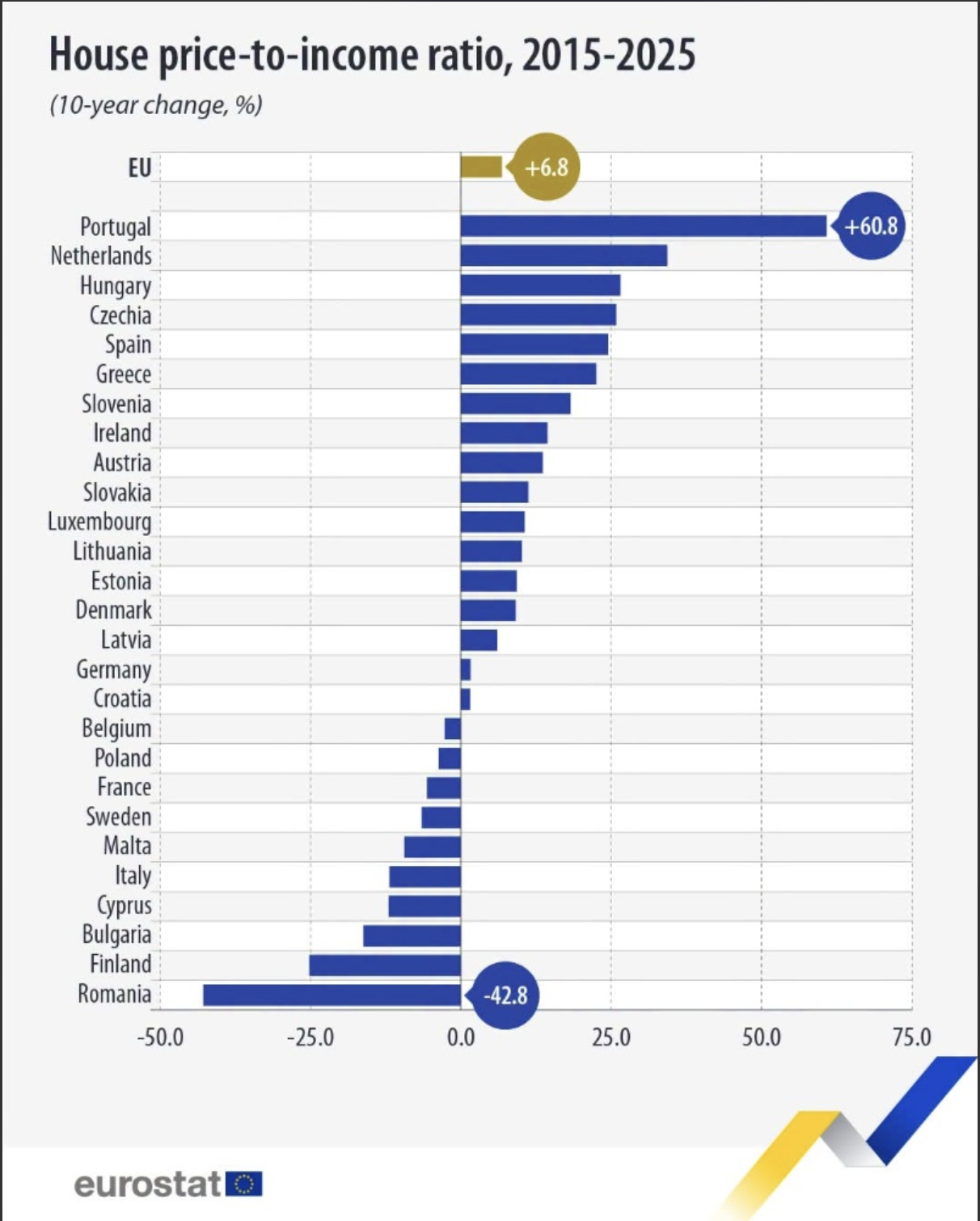
The Eurostat 10-year metric (2015–2025) paints an undeniable picture of structural failure. While the European Union average house price-to-income ratio shifted by +6.8%, Portugal stands as a stark anomaly of total extraction at +60.8%. Spain, Hungary, Czechia, and Greece follow closely in this dangerous divergence between local labor valuation and spatial cost.
Protocol as Infrastructure: Building the Anti-Elysium
When sovereign states refuse to enact legislative safeguards like the Dutch or Danish protocols, technology must cease being a tool of financial extraction and become an architecture of spatial sovereignty.
EuroUnits was engineered to act as an algorithmic firewall where regulatory courage has failed. By completely blocking traditional intermediaries, charging 0% transaction deal fees, and establishing a transparent peer-to-peer subscription model, we translate the Wet opkoopbescherming and Blackstone principles from legal texts into hardcoded protocol code.
We do not negotiate with usury. We build the architecture that makes it obsolete.
👉 Explore the sovereign protocol at EuroUnits.eu



Join The Discussion