
June 5, 1878
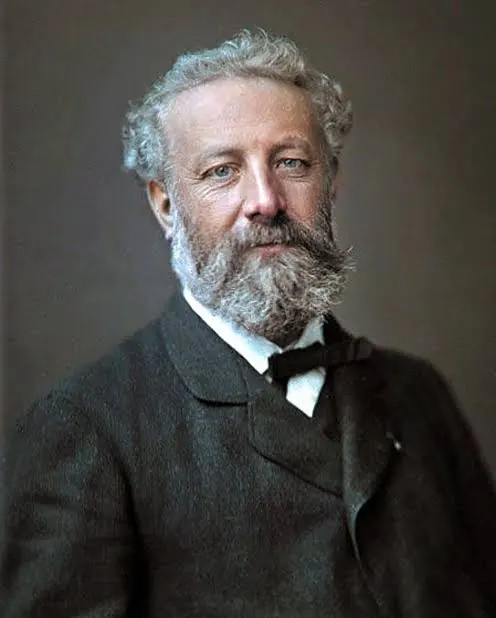
Lisbon received a visitor who seemed to have emerged directly from one of his own Extraordinary Voyages. Jules Verne arrived in the Tagus aboard his yacht Saint-Michel III, coming from Vigo, accompanied by his brother Paul Verne, Jules Hetzel Jr. (son of his iconic publisher), and former French deputy Raoul Duval.
He did not come as a rushed tourist. He had two days to experience Lisbon and decided to navigate the city at his own deliberate pace.
Day I: Among Books, Manors and the Edge of the Tagus
On that first morning, accompanied by banker Jorge O’Neill—representative in Lisbon of the French company Messageries Maritimes—Verne passed by the French Consulate and visited the Church of São Roque. After lunch, he met with David Corazzi, the Portuguese publisher of his works, at the offices of Empreza Horas Românticas on Rua da Atalaia, and visited O’Neill’s family residence.
As evening approached, the moment arrived that anchors this narrative: Jules Verne dined at the Grand Hotel Central in Praça Duque da Terceira, near Cais do Sodré—one of the most prestigious establishments in 19th-century Lisbon, offering an expansive view over the Tagus.
After dinner, there was still time for the theatre. Invited by Corazzi, Verne attended the zarzuela La Gallina Ciega at Recreios Whittoyne. Close to midnight, he returned to the Saint-Michel III, where he spent the night.
Day II: “For Verne, the Novelty Was Lisbon”
The following morning, his companions left for Sintra. Jules Verne chose to stay in Lisbon. The heat was intense, and as he would later record, his attention was entirely captured by the city itself. Writer Pinheiro Chagas summarized that choice in a particularly sharp sentence: “For Verne, the novelty was Lisbon.”
During the day, Verne received Captain João de Carvalho Ribeiro Viana, former director of the Naval Arsenal, aboard his yacht. The conversation centered on literature, naval engineering, and the new Portuguese cruiser Vasco da Gama, which particularly fascinated the writer. Ribeiro Viana sent him technical documentation on the vessel and received a written note of gratitude from Verne that very day.
In the afternoon, Verne explored the historic quarter of Belém, visiting the Belém Tower and the Jerónimos Monastery—seeking the architectural Lisbon that had survived the 1755 earthquake.
The Grand Hotel Central: Where Speculative Fiction Met Realist Literature
It was once again at the Grand Hotel Central that his Lisbon stay reached its literary zenith. There he met Manuel Pinheiro Chagas (editor-in-chief of Diário da Manhã), alongside Ramalho Ortigão and Rafael Bordalo Pinheiro—three fundamental figures of Portuguese cultural life.
Pinheiro Chagas left a striking portrait of the French author: a genial man with sharp, intelligent eyes, his golden beard starting to turn grey. Verne spoke modestly of his work and revealed he was currently writing A Captain at Fifteen.
When asked about the common French misconception of confusing Portugal with Spain, Verne asserted that this notion was fading in France, recognizing Portugal as a nation with a distinct identity and a fierce commitment to its sovereignty.
Later that evening, Verne visited Fernando Palha in Dafundo to inspect his private collection of rare books, art, and antiquities, before returning once more to his yacht.
At six in the morning on June 7, the Saint-Michel III weighed anchor, departing the Tagus toward Cádiz.
The Heritage Node
It was only 48 hours, but Jules Verne captured a very specific Lisbon: situated between the river, writers, journalists, naval engineering, and the halls of a hotel that, just a few years later, would be immortalized by Eça de Queirós in Os Maias. It is in the peristyle of the Grand Hotel Central that Carlos da Maia first glimpses Maria Eduarda.
When Verne dined there in 1878, the building was already a cornerstone of the European literary landscape. Though the hotel closed its doors in 1919, its structure remains today in Praça Duque da Terceira as a silent witness to a time when Lisbon served as a refuge and inspiration for the great world-builders of the continent.
Jules Verne departed by sea just as he arrived. And Lisbon remained permanently recorded in his real-world logbook.

Join The Discussion